CERI
Systems

Controllably Extendible Restraint Interconnection Systems
The purpose of this web site is to introduce you to a bold new concept in tactical police restraints called a CERI System. A CERI System is any one of several patented devices that utilize a ?Controllably Extendible Restraint Interconnection? System to extend the distance between either a set of handcuffs, or between a hand or leg cuff and an anchor point.
As police officers for the Hanover Park, IL police department, Shawn Beane and I developed the CERI Systems concepts with the thought in mind that the devices should be simple to operate with minimal training, and sufficiently durable to handle all types of restraint situations. We believe CERI Systems are the next logical stage in the evolution of tactical restraint systems, just as the extendible baton was the next logical step in non-lethal tactical weaponry.
There is a dark side to law enforcement that arises quickly and usually unexpectedly. It comes about when a confrontation leading to an arrest or detainment begins to go all wrong. When the person you are about to arrest or detain decides you are not going to arrest or detain him or her, a CERI System can be an extremely useful tool to have in your possession.
Law enforcement officers often encounter such situations. And the application of conventional forms of handcuffs to a subject is then made hazardous by the refusal or inability of the subject to allow his arms to be brought together behind his back so that the handcuffs may be properly applied to his wrists. Often it requires several officers to gain sufficient control over a resisting or oversized subject in order to compel his arms into close proximity so that the handcuffs may be attached to his wrists. The obvious problem with attempting to subdue a person under these conditions is that the arresting officer has no control over the distancing between the two wrist cuffs.
CERI changes that scenario completely. CERI hinged handcuffs unfold and lock to a standard length with a solid steel sliding bar that can only be released with a standard handcuff pin. The cuffs are used like any other tactical cuffs unless a subject becomes non-compliant or is unable to comply. Then a bottom-mounted, concealed release button is actuated to allow the left cuff to be swiftly separated from its rigid docking position and extended along a Kevlar belt tether to safely perform the wrist captures. A one-way, internal ratchet lock and tether retractor then act together to prevent the detainee from extending his wrists further apart, and to insure that his every movement will lead to a rigid closure or a controlled separation between the two cuffs. A concealed rear actuator button is then used to double-lock the tether belt ratchet position until a standard handcuff pin release is performed.
CERI Systems ? Controllably Extendible Restraint Interconnections
The drawing below is an artist's rendering of one example of a CERI Systems device.
Numerous other embodiments are possible and are indicated in the CERI Systems patent.
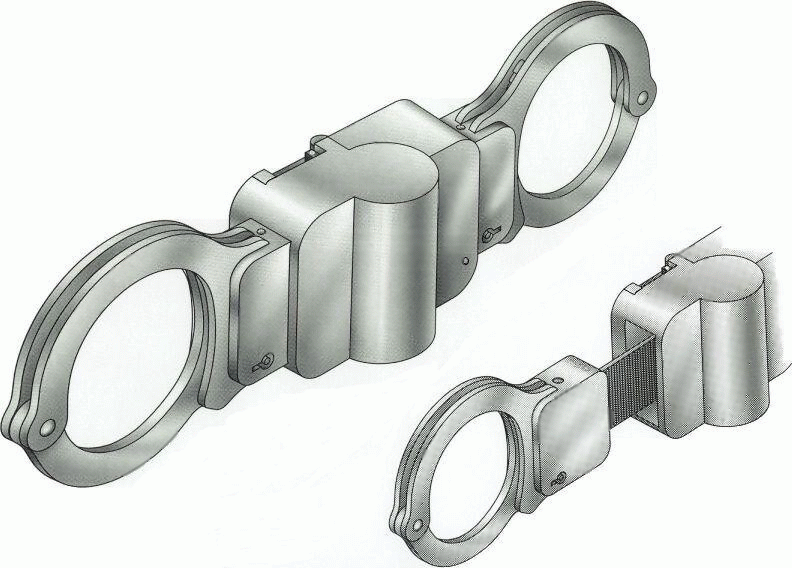
CERI Systems devices can be used to deal with non-compliant subjects, or
oversized subjects, or to temporarily restrain subjects to fixed objects by either placing a cuff
on a fixed object, or by placing the tether around a fixed object, such as a pole or a tree. Other
CERI Systems embodiments operate by replacing the fixed cuff with an anchoring device
fixed to a wall in a detention area, such as a processing room or a holding cell.
In a field of over 4000 submitted inventions, CERI Hinged Handcuffs ranked 43rd overall
in the History Channel 2005 - Modern Marvels Invent Now Challenge contest. The CERI U.S.
patent #7,210,317 issued on 050107. If you wish to review the CERI patent, you may either
click on the hyperlink to the U.S. Patent Office, or download a PDF copy by following the link below.
Reviewing the patent will not only give you a more clear idea of how the various
internal mechanisms of the CERI Systems devices operate, but will explain to you as well how
the device may be used to perform an arrest on either a compliant or non-compliant subject.
If you?re serious about handcuffs, then a CERI restraint system may be exactly what
you need. For further information regarding the licensing of CERI System patent rights,
please contact:
Officer Tom Chesters, Ret.
630-373-8862
To Download a PDF (2.79 Mb) copy of the
U.S.
CERI Patent Click Here -

To View the U.S.
CERI Patent Online Click Here -

Further Information on
Shawn
Beane

Also see: Portable Emergency Eye Flushing Method Web Site